

Timber acoustic doorsets · SD-TAD40
40 dB timber
acoustic doorsets .
SilentDoor Rw® 40T. Practical acoustic control. Detailed in timber.
Specify an Rw 40 dB timber acoustic doorset for offices, hospitals, public spaces, small music rooms, auditoriums and recording-studio support areas. The SilentDoor 40T combines a tri-layer acoustic core, rebated perimeter sealing and an automatic drop seal with a wide range of timber finishes.
Hear the acoustic comparisonSingle or double leaf, subject to specification · Timber, painted and laminate finishes
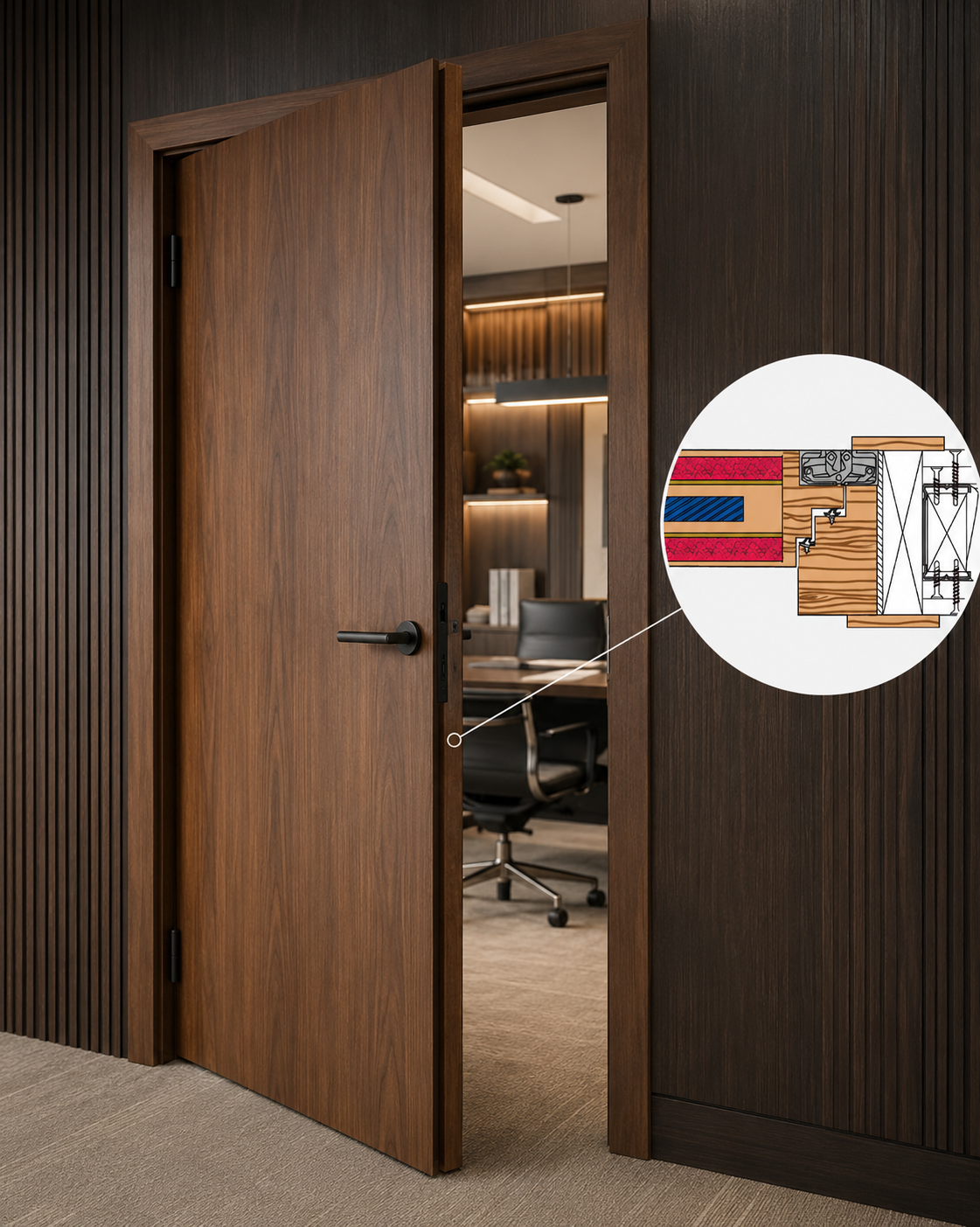
Weighted laboratory rating
Build-up and hinge option require confirmation
Plan hardware and handling early
Size, finish and configuration
01 / Inside the engineering
Acoustic door construction:
core, frame and seals.
A high acoustic rating depends on the leaf, frame, seals and threshold working together. Explore the construction that makes the 40T a serious timber acoustic doorset.
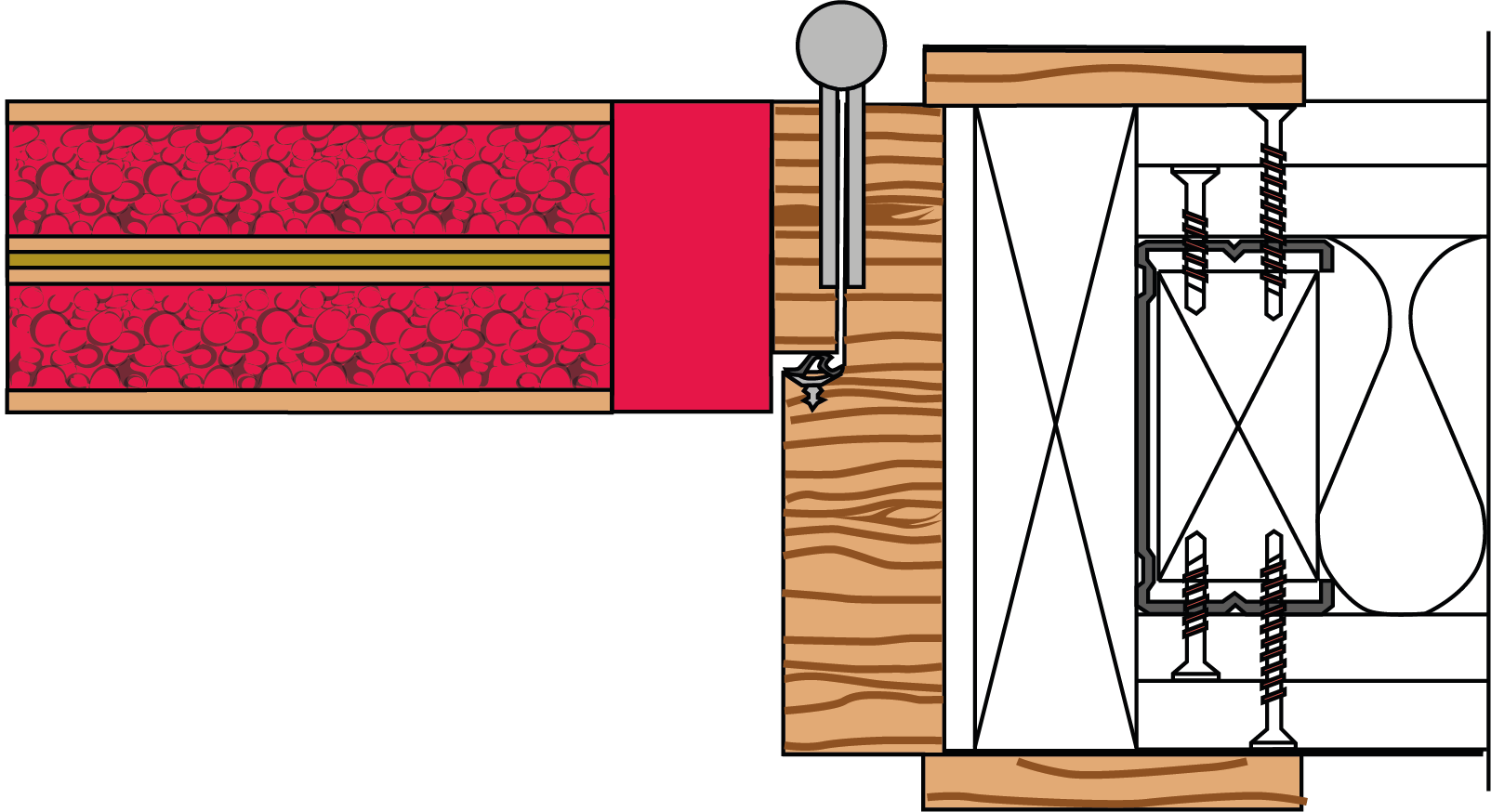
Illustrates the construction principle. Request the approved project detail for dimensions, fixings, hardware and seal positions.
01 Multi-layer acoustic core
A tri-layer core combines timber and acoustic insulation materials within solid perimeter rails. The outer skin completes the leaf and provides the foundation for your chosen finish.
Published construction guide: 55 mm leaf; 60 mm for the concealed-hinge option. Confirm the finished build-up.
02 Rebated perimeter. Controlled seal line.
A rebated leaf and perimeter seals reduce airborne sound leakage at the head and jambs. The seal contact, frame fixing and closing action need the same attention as the acoustic core.
The lower ratings still rely on precise perimeter control.
03 A coordinated frame and hardware
Frame material, hinge selection, fixings and the surrounding wall all need coordination. Timber and metal frame options allow the opening to be developed around the interior and project requirements.
Confirm compatibility across the complete assembly.
04 Control at the threshold
A mechanical drop seal addresses the gap beneath the leaf when the door closes. Floor finish, threshold level and final adjustment are essential details to coordinate before installation.
Small gaps can compromise an otherwise well-specified opening.
Moving from 35 dB to 40 dB represents about 68% less transmitted sound energy if that extra 5 dB applies uniformly across the sound spectrum. That is why small changes in the headline rating matter. Rw is a weighted rating; ask for the frequency-band data for your source.
02 / Experience the upgrade
Compare acoustic
door performance.
Choose an example source level, then switch between No door and a 40 dB doorset in the simplified model. Explore other ratings in the range to see why each 5 dB step matters. The audio uses a compressed listening scale driven by the calculated output level; it cannot reproduce measured room levels on your speakers.
For the same source, an additional 5 dB of uniform sound reduction corresponds to about 68% less transmitted sound energy. This is an illustration, not a prediction of installed performance. Enable JavaScript to hear the comparison.
Rw is a weighted sound insulation rating. It is not the noise level of a room, and it does not mean equal reduction at every frequency. For bass-heavy music or demanding room criteria, ask for the frequency-band test data and an assessment of the complete room.
03 / Technical specification
40T technical
specifications.
Use these 40T product particulars for early coordination. Final dimensions and performance need confirmation for the exact doorset, fire requirement, glazing and hardware combination.
- Product reference
- SilentDoor Rw® 40T Model SD-TAD40
- Acoustic performance
- Rw 40 dB Request the test report for the proposed configuration
- Leaf construction
- Tri-layer acoustic core Timber and acoustic insulation with solid perimeter rails
- Leaf thickness
- Confirm the selected build-up The published construction guide describes a 55 mm leaf and a 60 mm concealed-hinge option. Request the current approved detail to establish the finished thickness for your configuration.
- Approximate mass
- 43 kg/m² Use the estimator for early planning
- Arrangements & frames
- Single or double leaf Timber frame; metal frame option subject to specification
- Perimeter & threshold
- Rebated perimeter and acoustic seals Mechanical drop seal at the base of each leaf
- Fire performance
- Published range guide: up to 90 minutes Request matching fire evidence and approved scope for the required configuration.
- Vision panels
- Possible, subject to technical review Submit proposed dimensions. Availability, glass, beading and acoustic/fire compatibility must be confirmed for the complete doorset.
- Size envelope
- Published range guide: 3,500 mm high Single: up to 1,290 mm wide. Double: up to 2,580 mm overall width. Confirm the permitted size for the required acoustic/fire assembly.
Early design check
Plan for the weight.
Enter one leaf’s dimensions to estimate its mass using the published 43 kg/m² figure.
0.90 m × 2.10 m × 43 kg/m²
900 × 2,100 mm is an example and is not added to your brief. This is a mass estimate, not a size or hinge approval. It excludes any adjustment for glazing, ironmongery and other configuration changes. Confirm the final leaf mass and handling plan.
Start with the datasheet.
Find the timber acoustic doorset TDS, installation guide and maintenance documents in our downloads centre. Request the acoustic and fire evidence for your exact assembly.
Download TDS Request project-specific evidence Book a consultationSingle and double acoustic doors: configuration guide
Choose the acoustic, fire and glazing requirements together. The following entries reflect the published 40T selection guide and require confirmation against the evidence for your proposed doorset.
| Configuration | Leaf arrangement | Fire requirement | Specification note |
|---|---|---|---|
| 40T / acoustic-only requirement | Single or double | Non-fire-rated or project review | Coordinate acoustic assembly, dimensions, frame and hardware. |
| 40T / fire-rated requirement | Single or double | Up to 90 minutes published range guide | Request matching EN 1634-1 evidence, classification and approved configuration before specifying. |
| 40T / glazed requirement | Single or double | Subject to fire/acoustic review | Confirm the permitted vision-panel size, glass, beading and configuration evidence. |
The guide is not a test certificate. Maximum overall size, vision-panel area and fire performance must not be combined as independent allowances. Smoke-control performance requires separate confirmation.
Acoustic test evidence: what to request
Rw and frequency-band results
Rw is a weighted single-number rating. Ask for the sound reduction index, R, by frequency as well as the headline rating, especially where amplified music or low-frequency noise drives the brief.
Measurement and rating methods
ISO 10140-2 describes laboratory airborne sound-insulation measurement; ISO 717-1 describes its rating. Ask which standards and editions the supplied report uses, and check the tested specimen and installation.
The assembly behind the result
Confirm leaf arrangement, dimensions, frame, seals, threshold, glazing and ironmongery against the test evidence. A different combination needs review; the model name alone does not establish the approved scope.
These standards explain how to read acoustic evidence; their inclusion here is not a declaration that every 40T configuration has been tested to each named standard.
Frames, ironmongery and installation coordination
Structural opening and clear access
Record the structural opening, finished floor level, wall construction and required clear opening separately. Confirm handing, swing direction, frame profile and fixing detail on the project drawing.
Leaf mass and door operation
Coordinate hinges, closer, latch and any access-control hardware with the final leaf mass. Check closing action, seal engagement and the required opening effort as part of the complete hardware specification.
Sealing and the surrounding room
Coordinate the frame-to-wall junction and a suitable threshold surface for the drop seal. Review flanking paths through adjoining construction and services; sound can bypass the doorset.
04 / Material expression
Timber veneers and
doorset finishes.
Make the doorset part of the interior. Explore timber veneer references, request a painted or laminate finish, or send us a sample to discuss a coordinated match.
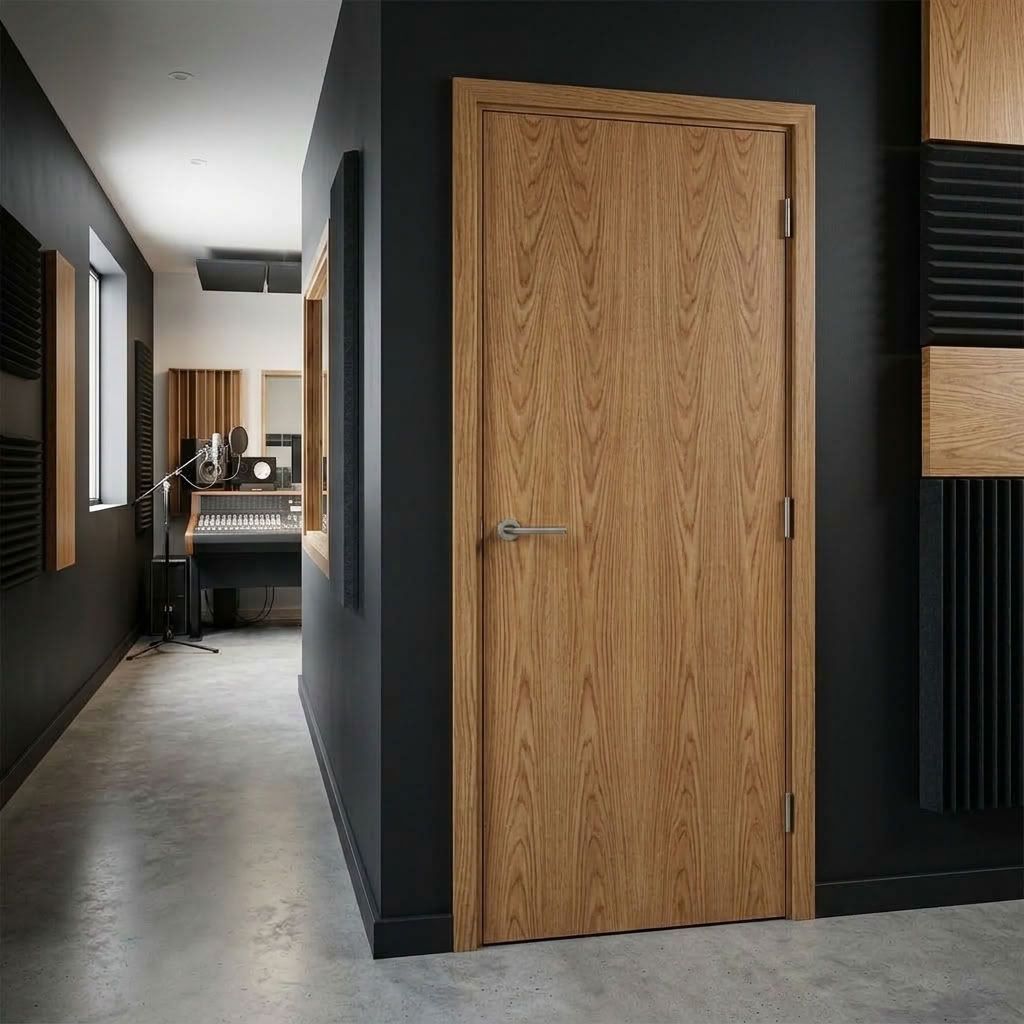
Explore a finish
Natural character. Carefully coordinated.
A lighter timber reference for interiors that bring grain and material warmth into focus. Confirm the veneer, cut and finish with a physical sample.
Screen images are indicative. Natural veneers vary in colour and grain. Availability, matching and suitability for your doorset require confirmation.
Explore leaf and frame finishes in 3D05 / Design for the room
Acoustic doors for
demanding sound environments.
Consider the 40T where speech privacy, music practice or general noise transfer needs controlled acoustic separation without moving into the heavier specialist studio ratings. Select the doorset from the acoustic criteria for the whole room.
Healthcare & public spaces
Reduce sound transfer around consultation rooms, meeting areas and shared circulation while coordinating finish, fire requirements and accessibility.
Small music rooms
Coordinate door performance with the surrounding wall, floor and ceiling so the opening does not become the weak point in a practice room.
Offices & education
Use 40T where privacy and concentration matter: boardrooms, classrooms, rehearsal spaces and mixed-use commercial interiors.
06 / Your project, clearly defined
Specify your 40 dB
timber doorset.
Choose your initial requirements, then copy, download or email the brief for review. Add project drawings and a door schedule when you contact us.
- Arrangement
- Single leaf
- Fire requirement
- Please advise
- Frame
- Timber frame
- Vision panel
- No vision panel
- Preferred finish
- Please advise
Requirements for review, subject to technical confirmation.
Email opens a draft in your email app.
Will an Rw 40 dB doorset make my room silent?
No doorset can guarantee silence in every room. Rw describes weighted sound insulation under laboratory conditions. The source spectrum, background noise, surrounding construction and installation all influence what you hear on site.
Why can a few extra decibels cost more?
Decibels use a logarithmic scale. A uniform 5 dB improvement leaves about 32% of the previously transmitted sound energy; a 10 dB improvement leaves 10%. Achieving higher doorset performance can call for different construction, greater mass, more demanding sealing and compatible hardware. Compare the complete specification and test evidence.
Can I combine acoustic performance, fire resistance and glazing?
These requirements must be checked as a combination. A rating or maximum size for one build-up should not be assumed to apply to another. Send your fire requirement, arrangement and proposed vision panel size so the corresponding assembly and evidence can be reviewed.
How should I choose between 40T, 45T and 50T?
Start with the room criteria and how disruptive the source is. A 45T or 50T doorset can be worth the upgrade where privacy, music or recording quality matters. Compare frequency-band data and the surrounding construction rather than relying on the headline number alone.
How heavy is a 40T timber acoustic door?
The published guide is approximately 43 kg/m². A 900 × 2,100 mm leaf therefore gives an illustrative estimate of 81.3 kg before adjustments for the exact build-up, glazing and ironmongery. Confirm the final weight and coordinate hinges, closer, fixings and handling.
What matters during installation and maintenance?
Follow the approved installation instructions for the frame, fixings, perimeter gap treatment, seals and threshold. Check that the leaf closes correctly and that seals engage as intended. Ongoing alignment and seal condition matter to the performance of a working door.
Are acoustic doors and acoustic wall panels doing the same job?
An acoustic doorset helps limit airborne sound passing through an opening. Absorptive wall and ceiling finishes address reflections and reverberation inside a room. A studio may need both, with the door, walls, floor, ceiling and ventilation considered together.
Does an acoustic rating also establish fire or smoke performance?
No. Acoustic, fire-resistance and smoke-control performance are different requirements. EN 1634-1 concerns fire-resistance testing of door assemblies; EN 1634-3 concerns smoke-control testing. Request the relevant evidence and classification for the actual doorset rather than inferring one performance from another.
What should I send for a quotation?
Send the door schedule, opening sizes, quantity, acoustic and fire requirements, handing, vision panel needs, finishes and ironmongery preferences. Include the site location, project drawings and programme where available.
08 / The timber acoustic range
Find the acoustic rating
your project needs.
Compare the 40 dB, 45 dB, 50 dB, 55 dB and 60 dB timber acoustic door models. Review each model’s configuration limits and test evidence alongside its headline Rw rating.